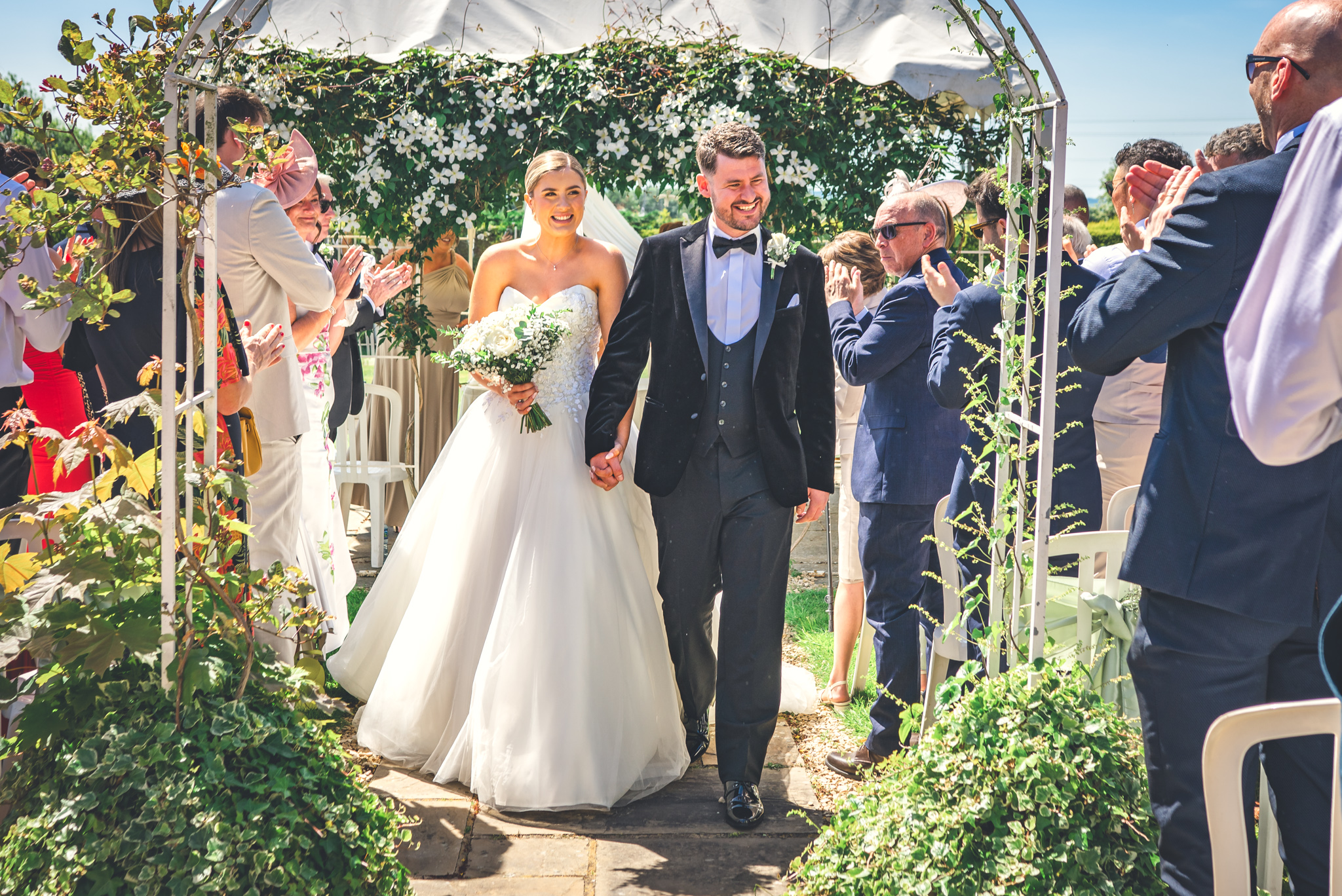
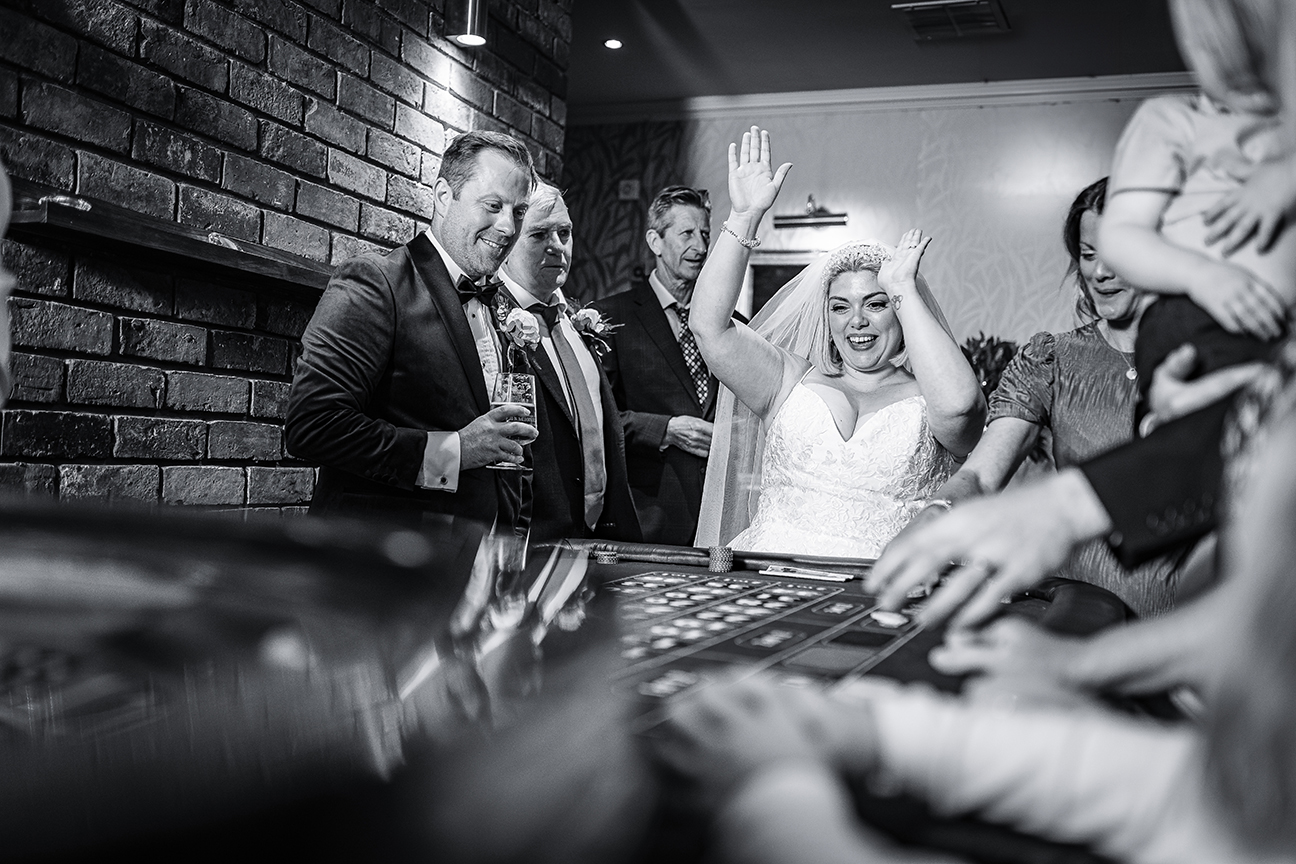
Rain might change where parts of your wedding happen, but it does not stop the wedding or the photographs. Here is what genuinely changes and what is worth planning.
Planning Advice — Wet-weather weddings
The wedding still happens
The honest answer is that very little changes when it rains on your wedding day.
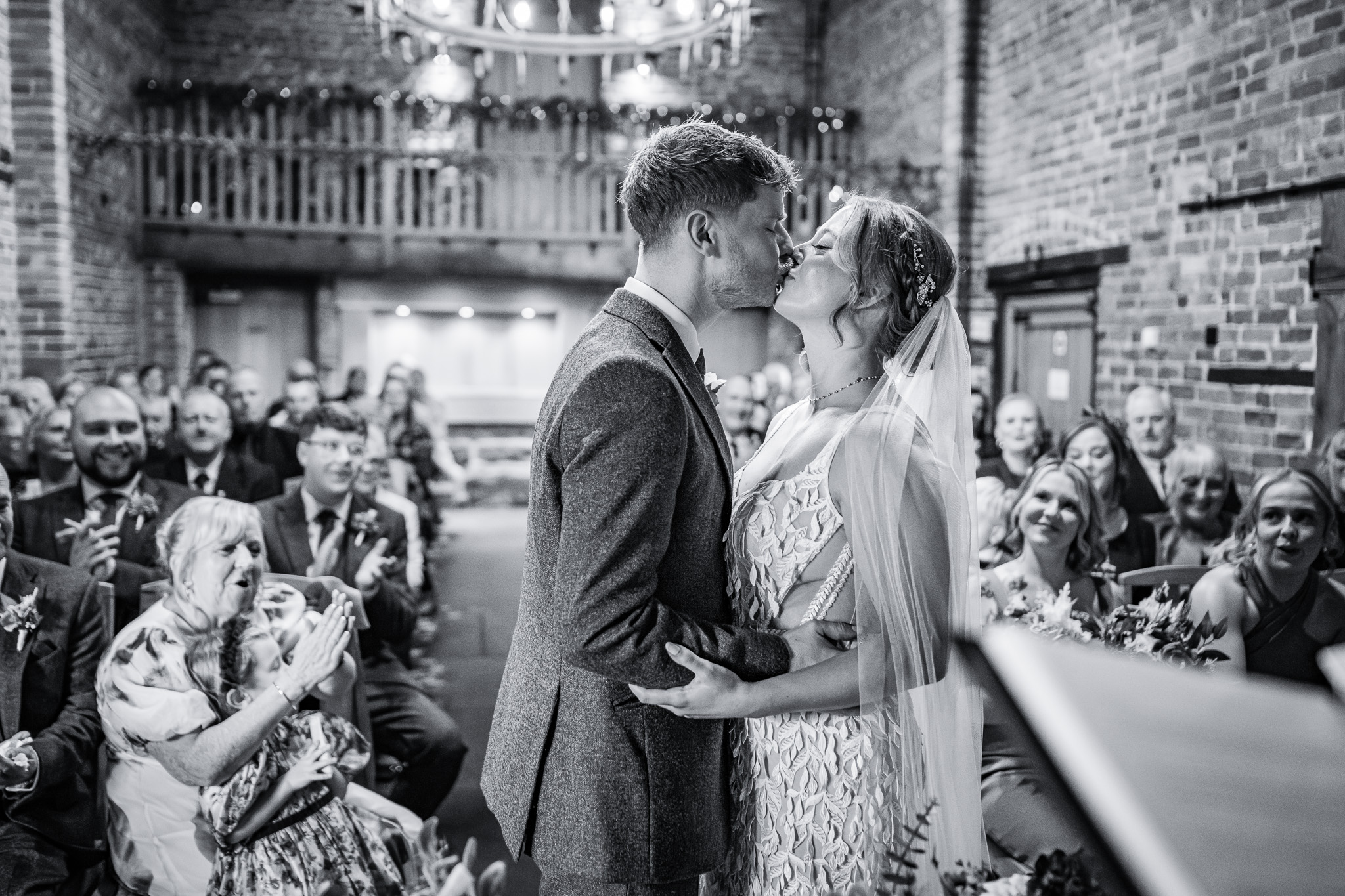
You still get ready. You still get married. The meal, speeches, first dance and most of the candid photography carry on exactly as they would have done in the sunshine. The main difference is where people spend their time and whether the two of you are willing to step outside for photographs.
After more than 500 weddings, I can only remember a couple where rain genuinely damaged the day. In both cases, the entire wedding had been planned around being outdoors without a workable alternative.
British weather changes quickly. I have arrived at weddings in steady morning rain, told the couple it looked likely to blow through and found the ground dry again by the time they came out of the wedding breakfast. I have also photographed July weddings where the rain settled in for the day.
Summer improves your odds, but it does not come with a guarantee. Outside the summer, rain, cold and short daylight are part of the bargain.
Long-range forecasts are not reliable enough to deserve weeks of worry. By the time the forecast becomes meaningful, the venue is booked, the suppliers are paid and the wedding is happening anyway. Keep an eye on practical information close to the date, particularly Met Office weather warnings, but checking the forecast every six minutes will not move the cloud.
You cannot control the weather. You can control how much of your wedding day you allow it to take over.
A beautiful lake, open countryside or acres of gardens can be a genuine reason to choose a wedding venue. Just remember that you are booking the building as well as the view.
If rain keeps everybody inside, those rooms become the whole wedding. Look at them with the same care you give the view.
Ask yourself:
• Can every guest fit indoors comfortably, rather than technically?
• Where will the drinks reception happen?
• Is there enough room for family photographs?
• Does the building have large windows and useful natural light?
• Are there separate rooms where guests can move or have a quieter ten minutes?
• Is there a porch, covered courtyard or sheltered entrance that can still be used?
• What happens if an outdoor ceremony has to move inside?
A room may be advertised for 100 or 120 people, but that does not mean the same number will be comfortable standing there for a two-hour drinks reception. Put everybody into a small space and it quickly becomes hot, loud and tiring, particularly for older guests.
Curradine Barns works very well when guests can spread into the courtyard, but the drinks-reception area feels much tighter with a large wedding when everybody must stay inside. My Curradine Barns winter wedding guide looks more closely at the light and shorter portrait windows there.
Multiple indoor rooms make a substantial difference. At Eastington Park in Gloucestershire, guests can move between several downstairs spaces rather than spending the whole reception on top of one another. On-site accommodation also gives anybody who gets soaked somewhere to dry off or change.
For a winter wedding, look at the light inside too. A barn or listed building with tiny windows can become extremely dark on a wet afternoon, and registrars do not always allow flash during the ceremony.
DIY, farm and marquee weddings need more than a roof
Wet weather becomes harder to solve when you have built the venue yourself.
I photographed a summer wedding in 2021 after the couple's original venue could not accommodate their rearranged post-Covid date. Friends owned the pub beside the church, so the reception went into a marquee in the pub garden.
The day was dry until the couple left the church. Then it rained for the rest of it.
The marquee had been placed directly onto grass without a proper floor. As more water came down and more people walked through it, the inside gradually became a swamp. By the evening, the bottom of the bride's dress was brown and steadily drawing more water upwards.
There was nothing useful anybody could do by that point. The wedding was already happening.
If you are planning a farm, back-garden or marquee wedding, think beyond whether the canvas keeps rain off the tables. Consider proper flooring, drainage, access for suppliers, the route guests will walk and where water will travel if the structure sits at the bottom of a slope.
A marquee at the bottom of a hill with no floor is not a wet-weather plan. It is a future mud bowl.
Outdoor ceremonies need an operational backup plan
Ask the venue when the final decision about an outdoor ceremony will be made and whether the indoor room will already be prepared.
At one recent wedding, the ceremony was due to begin at 2pm. At ten past two, the rain worsened and the registrars decided it had to move indoors. The venue had not set up the alternative room, so moving everything took another 30 minutes.
The wedding still happened and the delay was manageable. However, the couple had booked only two hours of photography. Half an hour was suddenly a significant part of their coverage.
That was nobody's fault, but it shows why a backup plan needs to be operational rather than theoretical. If you have booked short coverage around an outdoor ceremony, leave some room for the plan to change. A delay may mean adjusting what fits into the time or paying for extra coverage if the photographer is able to stay.
You can read more about matching the hours to the real schedule in Do We Need a Wedding Photographer for the Whole Day?.
What happens to the group photographs and couple portraits?
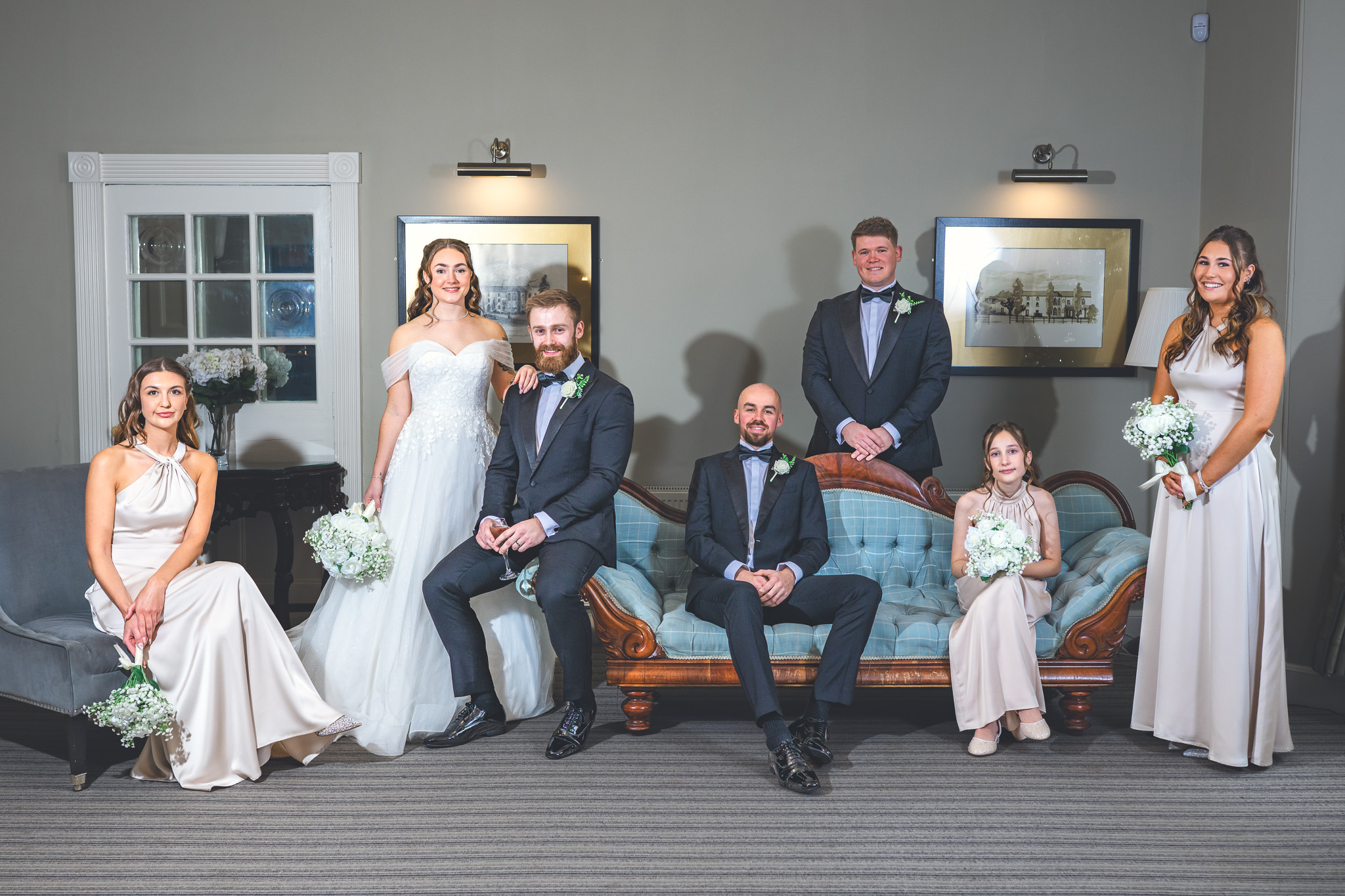
If the outdoor location is unusable, we do the family photographs indoors or under cover. If a dry spell looks likely, we may wait.
There is no universal indoor setup. A hallway that works for 40 guests may be impossible with 100 people standing in it. Furniture moves, rooms fill and the light changes, so I make that decision on the day.
The background may be different from the one you imagined. The important people are still there.
This is another reason to keep the group list realistic. Ten meaningful combinations are much easier to move through a short dry gap than 35 variations involving the same increasingly damp relatives.
With the couple portraits, we normally keep our options open.
If it looks as though the rain will clear, we can wait. There is little value in getting soaked before the wedding breakfast and then discovering it is dry afterwards.
If the rain has settled in, I will look at indoor and covered options. A staircase, doorway, window, corridor or clean wall can all work in experienced hands. We can also split the portraits into several short periods.
Then there is the simple option of going outside.
You do not have to, and I will not turn your wedding into my photoshoot. I will normally ask once, explain the opportunity and leave the decision with you. If you say no, I am not going to sulk in a corner because my portfolio wanted another rain photograph.
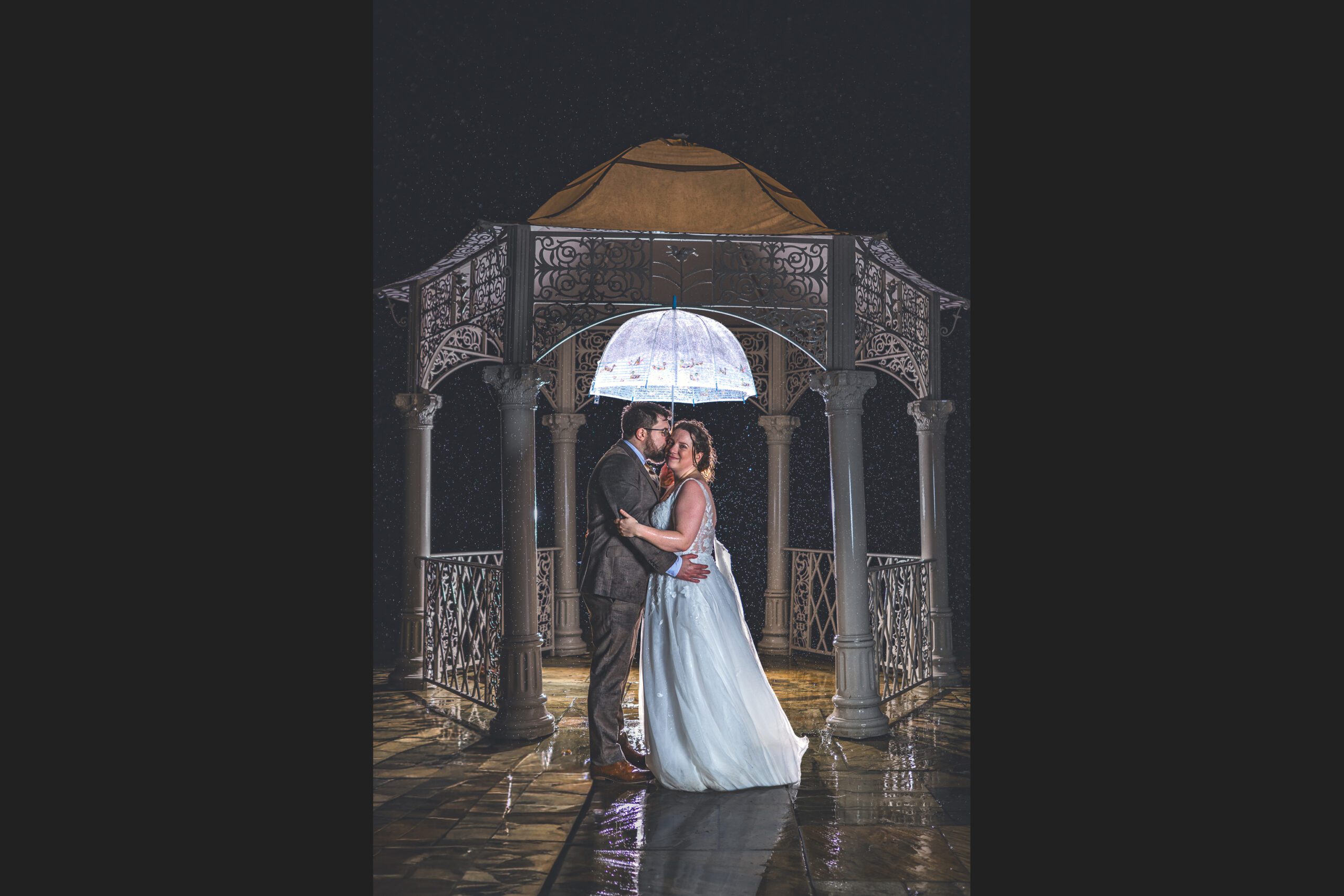
However, if you are willing to step outside for a few minutes, the weather can give you something none of your friends had on a dry summer afternoon. Those photographs can be darker, moodier and much more atmospheric.
Rain does not automatically mean fewer photographs
A wet wedding normally produces a different balance of photographs, not an incomplete gallery.
Preparations, ceremonies, speeches, meals and dancing do not disappear because the lawn is wet. I photograph weddings throughout the year and do not need sunshine to produce a complete story.
Persistent rain can reduce the space available for candid photographs. If 100 people are confined to one small room, there are fewer clean viewpoints and everybody is standing on top of everybody else. A venue with several indoor rooms gives the guests and the photographer more room to work.
This is why I would look beyond one spectacular umbrella portrait when choosing a photographer. Ask to see complete galleries from winter weddings, dark ceremony rooms and days where the light was difficult. Summer weddings can be comparatively forgiving. By November or December, daylight may have disappeared by 3pm and experience becomes much easier to see.
My guide to choosing a wedding photographer explains what complete galleries can tell you that a highlights page cannot.
Overcast light is lovely. Rain is not automatically a gift
Wedding photographers sometimes oversell rain as though we are all secretly hoping for it. I am not.
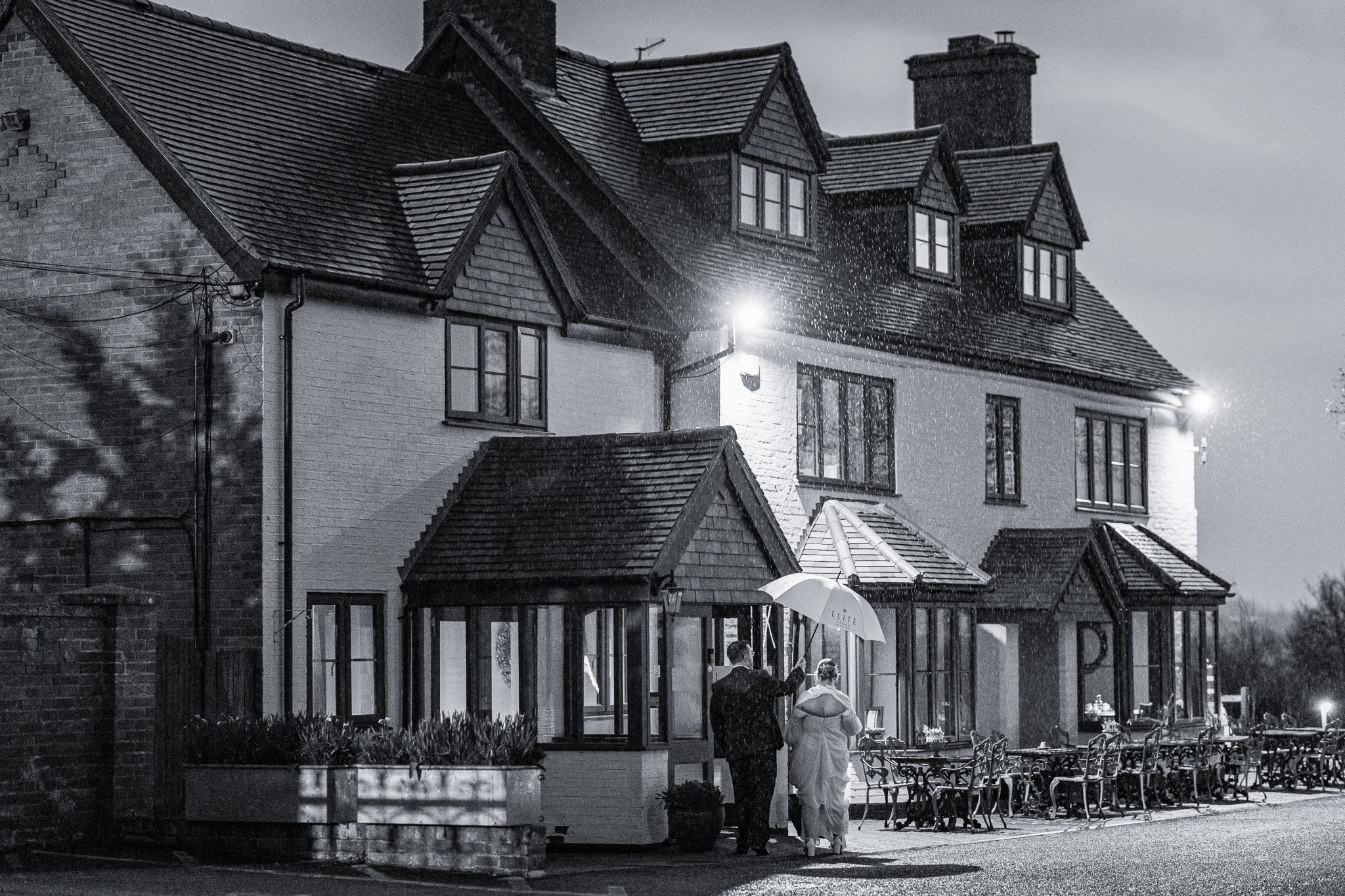
Overcast light is excellent for photographs. It is soft, even and usually kinder to faces and colours than hard midday sun. Rain itself can create reflections, wet surfaces, darker skies and puddles that make me look at a familiar venue differently.
It can also change people's mood. Guests stay indoors, plans move and everybody can feel slightly more on edge. Rain never guarantees better photographs. It creates different opportunities.
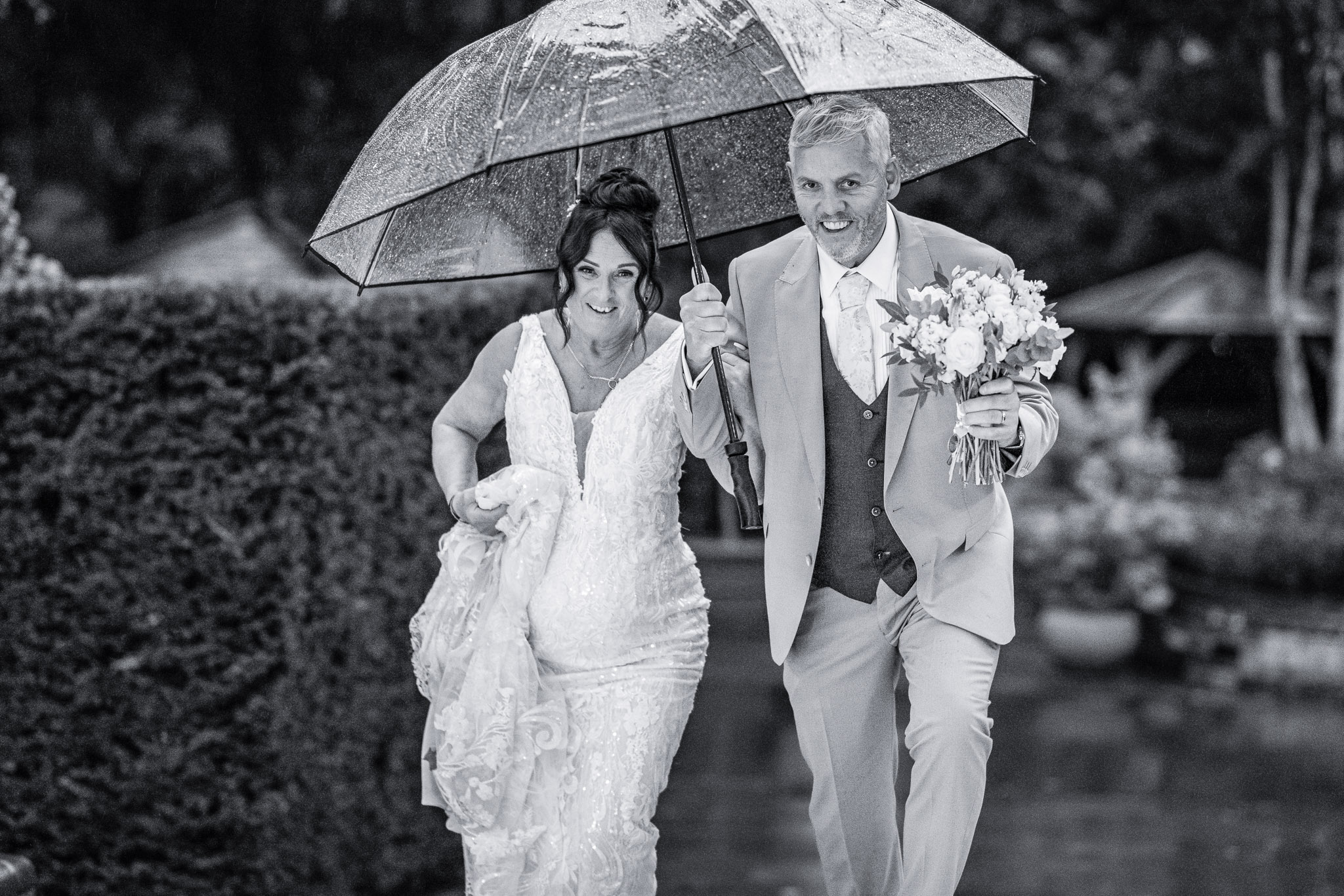
From a documentary point of view, it also becomes part of the wedding. Guests sprinting for cover with an order of service over their heads, umbrellas colliding, muddy hems and everybody squeezing together in a doorway are real parts of what happened. If it rains all day, leaving that out of the gallery would be stranger than photographing it.
Two photographs that would not exist without the rain
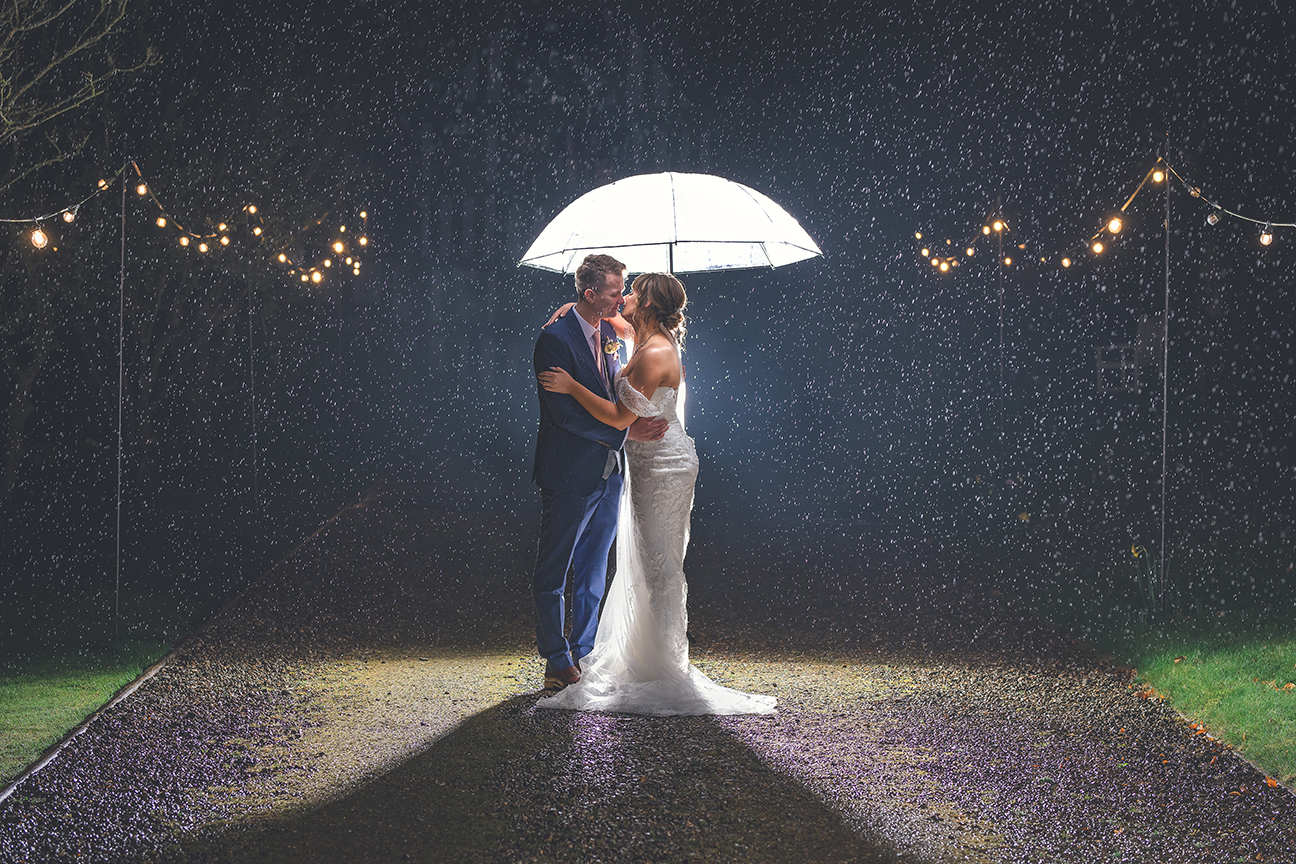
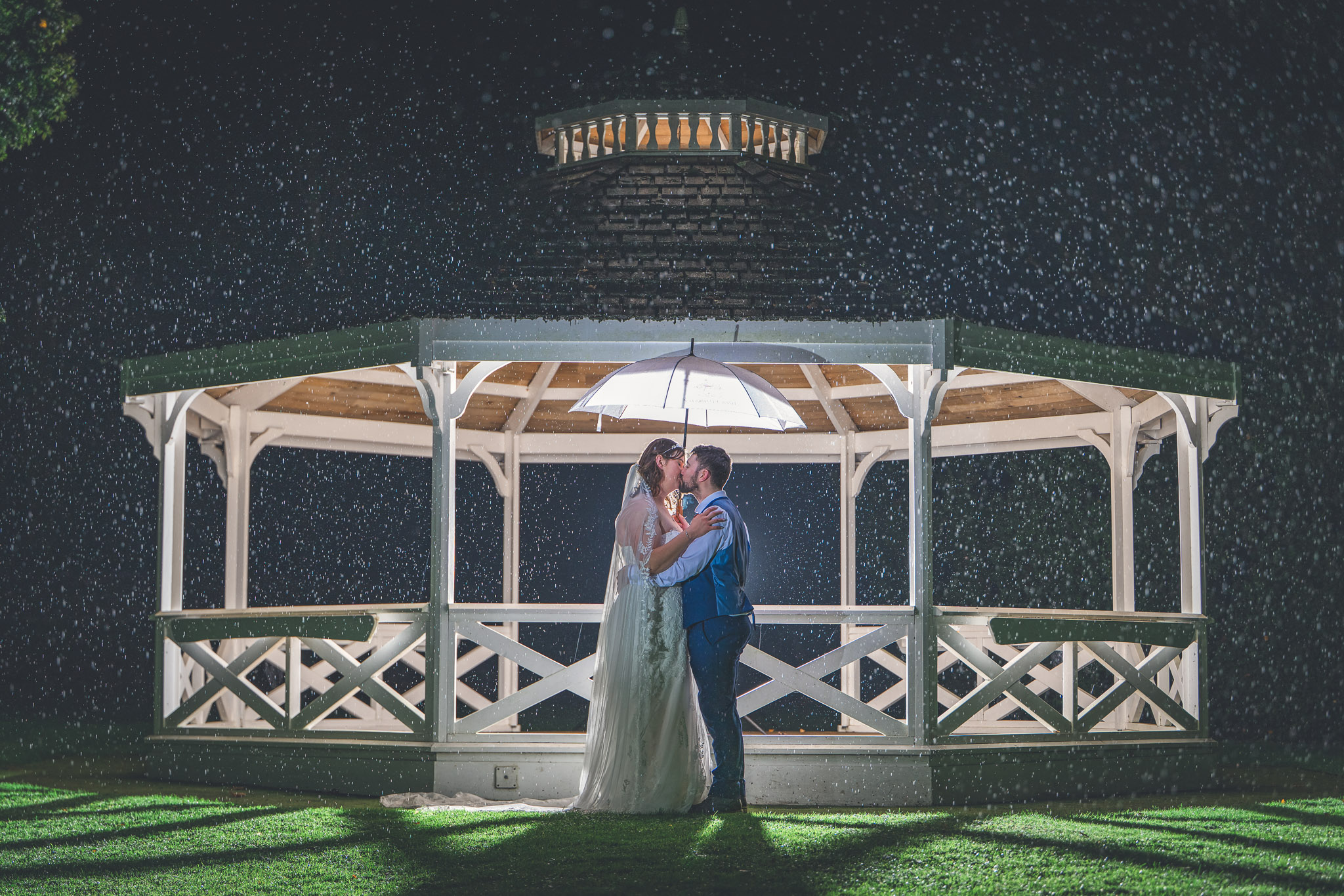
Matt and Lauren married at High Grosvenor House in March. Most of their wedding was dry. The rain arrived properly in the evening, after the meal, cake and first dance.
It was heavy enough that the outdoor photo booth they had paid for was barely being used. They still wanted their sparklers, and when I suggested making a portrait in the rain, they embraced it without hesitation.
The result is still one of my favourite rain photographs. What stays with me just as much is their response. They did not spend the evening wishing the weather away. They treated it as part of their wedding and came away with something they could never have planned.
You can see the photograph in Matt and Lauren's High Grosvenor House wedding.
Hannah and Jack had a similar choice at Eastington Park in Gloucestershire in February 2026. The day was cold, so much of the photography happened indoors anyway. When rain arrived later, I asked whether they wanted to go outside.
Hannah had seen the wet-weather work in my portfolio and was more than willing. When I showed her the finished portrait on the back of the camera, her exact response was, "I look like a princess."
That is a better argument for rain photographs than pretending the weather is always wonderful.
Rain photographs are quick, optional and subject to common sense
The dramatic evening rain portrait is a small part of the day, not a lengthy technical exercise.
There is a method behind making rain visible and shaping the light properly, but the important information for a couple is simpler: it is planned quickly, it is optional and I will not leave you standing in heavy rain while I experiment.
It is also not something I will attempt regardless of the conditions. Sideways rain with extreme winds, lightning, flooding or dangerous ground moves the decision from creativity to safety. No photograph is worth somebody being injured by flying debris or slipping where the ground has become unstable.
My equipment is weather sealed, not waterproof. I had a camera water damaged during a wedding badly enough to require an insurance claim. There comes a point where the sensible professional answer is no.
Bring things that make the decision easier
You do not need to arrive with an expedition kit. A few practical choices make going outside much easier:
• Comfortable shoes for most of the day
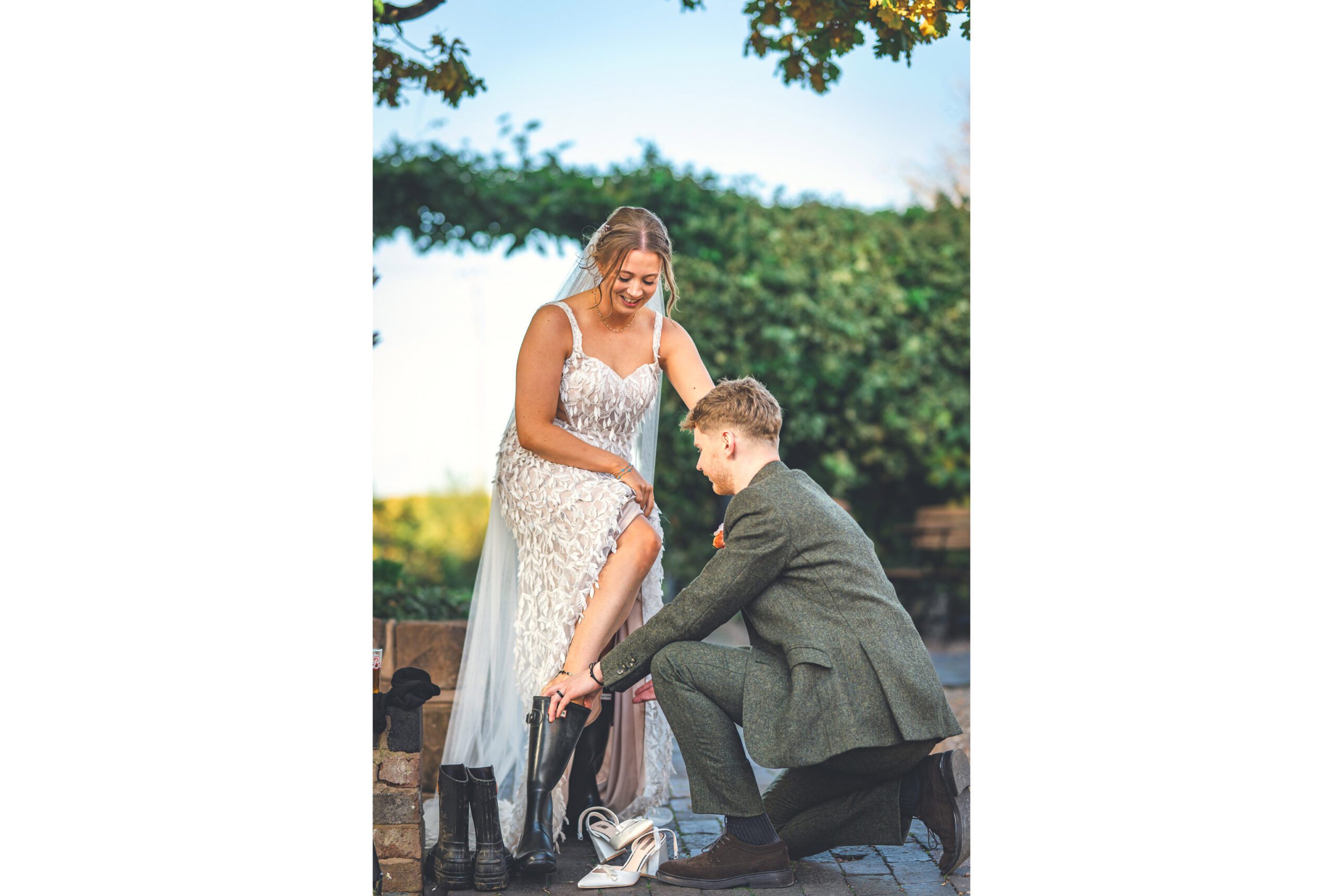
• Wellies if the venue has fields or muddy ground
• A coat or wrap that works with the outfit during colder months
• Plain, white or clear umbrellas rather than branded golf umbrellas
• A realistic attitude towards the bottom of the dress
Very few brides remain in high heels from morning until midnight. By the end of the wedding breakfast, the Crocs have normally appeared. There is no prize for lasting longer than your feet.
The same applies to the dress. I understand wanting to protect it during the ceremony and formal parts of the day. By 8pm or 9pm, worrying about a small amount of rain or mud can cost you an opportunity you would value far more than a perfectly clean hem. Dresses can be dry cleaned. That particular evening cannot be repeated.
If the dress, hair, makeup or shoes matter more to you than the photograph, I will work within that without trying to wear you down.
Frequently asked questions about rain on a wedding day
How much dry time do we need for wedding photographs?
EXPAND
A short break can be enough for the important family groups or a set of couple portraits, particularly if the list is sensible and everybody is ready. We can also split the photographs across several small gaps.
Do we need to provide umbrellas?
EXPAND
Check what the venue and photographer already have. If you provide your own, clear, white or plain umbrellas are generally less distracting in photographs than bright patterns, logos or checked golf umbrellas.
Can an outdoor ceremony continue in light rain?
EXPAND
That decision normally belongs to the venue and the person conducting the ceremony, with safety, paperwork, guests and the forecast all affecting it. Ask in advance who makes the call, when it will be made and whether the indoor room will already be ready.
If it rains on your wedding day, let it be part of the day
You cannot change the weather. You can change how much power you give it.
Use the indoor spaces. Wait for a gap. Put the wellies on. If you fancy it, step outside for five minutes and make a photograph that could not have existed on a dry day.
Ten years later, you are unlikely to remain annoyed that it rained after the first dance. You are much more likely to remember everybody running for cover, the state of the dress and the photograph on the wall that would not exist without it.
Rain might change the background. It does not change the reason everybody is there.
If you want a photographer who is comfortable in dark rooms, winter light and weather that changes its mind halfway through the ceremony, tell me what you are planning. I will work around the wedding you actually have rather than wishing it looked like somebody else's.